NewKai Coach: the AI coach that never writes the paper

INTRODUCING KAI

The AI that knows your course and is built to teach, not to cheat.

KAI has read your course: the chapter, its figures and its homework. It explains ideas and coaches students through graded questions instead of answering them. Included in every Kudu course at no extra cost. In an independent, peer-reviewed study, Kudu’s AI hints were associated with higher exam scores.

  1. Student

    A larger volume means more mass so more force

  2. Kai Coach

    Let’s test that idea with a point in the water.

    Round 1 of 10

    At the bottom of a 3 m swimming pool and 3 m below the surface of a huge lake, would your ears experience different pressures? Why?

New in KAI

Kai Coach: the AI coach that never writes the paper.

Socratic coaching modules built on your course’s own readings, and built by Kudu at no cost to your institution. When a student is stuck, Kai Coach may supply a term, never the reasoning.

Explore Kai Coach
  • 2×developed arguments per paper
  • 73%stated a clear position, up from 43%
  • 87%of final exams cited a specific reading, up from 7%

WHAT IT IS

A tutor that’s read your textbook. And only your textbook.

Most AI assistants are general-purpose tools your students will use whether you assign them or not. KAI is the alternative — built into Kudu courses, scoped to the actual course content, and designed by educators to help students learn rather than help them avoid learning.

01 — COURSE-AWARE

Grounded in your textbook, not the open internet.

KAI uses the actual content of your Kudu course — the textbook, the worked examples, the homework framing — as ground truth. When a student asks about Chapter 4, KAI is reading Chapter 4. The answers come from the same content the student is being taught from, in the same notation and with the same conventions.

02 — DIDACTIC, NOT SOLUTION-DUMP

Guides students through the problem instead of doing it for them.

Faculty write the system prompts that tell KAI how to behave, and the default behavior is to ask leading questions, give partial hints, and walk students toward an answer they construct themselves. KAI will not solve a homework question outright. It will teach a student how to.

See it in Kai Coach
03 — EQUITABLE BY DEFAULT

Premium AI for every student. No pro tier gating.

Every student in a Kudu course gets the same KAI capability: frontier models, full features, no rate limits during normal study. Students who can't afford ChatGPT Plus get the same tutor as students who can. AI access becomes a leveler in the classroom rather than another form of inequality.

04 — PRIVACY BY ARCHITECTURE

Anonymized at the routing layer. No training on student data.

Student queries are anonymized before they reach a model provider. We use providers under contractual no-training guarantees. We never sell, share, or use queries to train anything. Your data leaves Kudu only as anonymized text and the answer comes back the same way.

OUR POSITION

Five things we believe AI in education has to get right.

If a vendor's AI doesn't honor each of these, the institution is taking on risk the vendor isn't carrying. KAI is built to honor all five.

Equity comes first.

State-of-the-art AI cannot become another line on the list of things students with money can buy and students without cannot. Every Kudu student gets the same KAI, regardless of family income, regardless of the tier their classmates can afford outside class. Equitable access is not a feature we charge extra for. It is the design constraint that everything else fits around.

Pedagogy outranks capability.

An AI that can solve any homework problem is a worse education product than an AI that cannot. KAI is deliberately constrained to teach rather than perform. It will ask leading questions. It will give partial hints. It will tell a student they are close. It will not write the essay or solve the integral. The goal is the student's learning, not the convenience of the answer.

Course context, not the open internet.

Most AI hallucination problems disappear when the model is given accurate course context and can answer from the course's approved material. KAI is grounded in the actual textbook of the course it is deployed in. Faculty can see what KAI knows because faculty wrote or approved the source material. The result is an AI that is wrong less often and, when it is wrong, wrong about things faculty can correct.

Privacy by architecture, not by promise.

Anyone can write a privacy policy. KAI is structured so that even if we wanted to train on student data, we could not. Queries are anonymized at the routing layer before they reach a model provider, and the providers we use are contractually bound not to train on what they receive. The architecture is the guarantee, not the marketing copy.

Institutions shouldn’t have to pick an AI vendor.

The frontier model landscape changes every quarter. Today's best provider is tomorrow's also-ran. Kudu holds the relationships with multiple frontier model providers so institutions do not have to. KAI is model-agnostic by design. When a better model arrives, we route to it. Your campus gets frontier capability without signing frontier contracts.

INDEPENDENT RESEARCH

KAI doesn’t just feel helpful. It’s been measured to be.

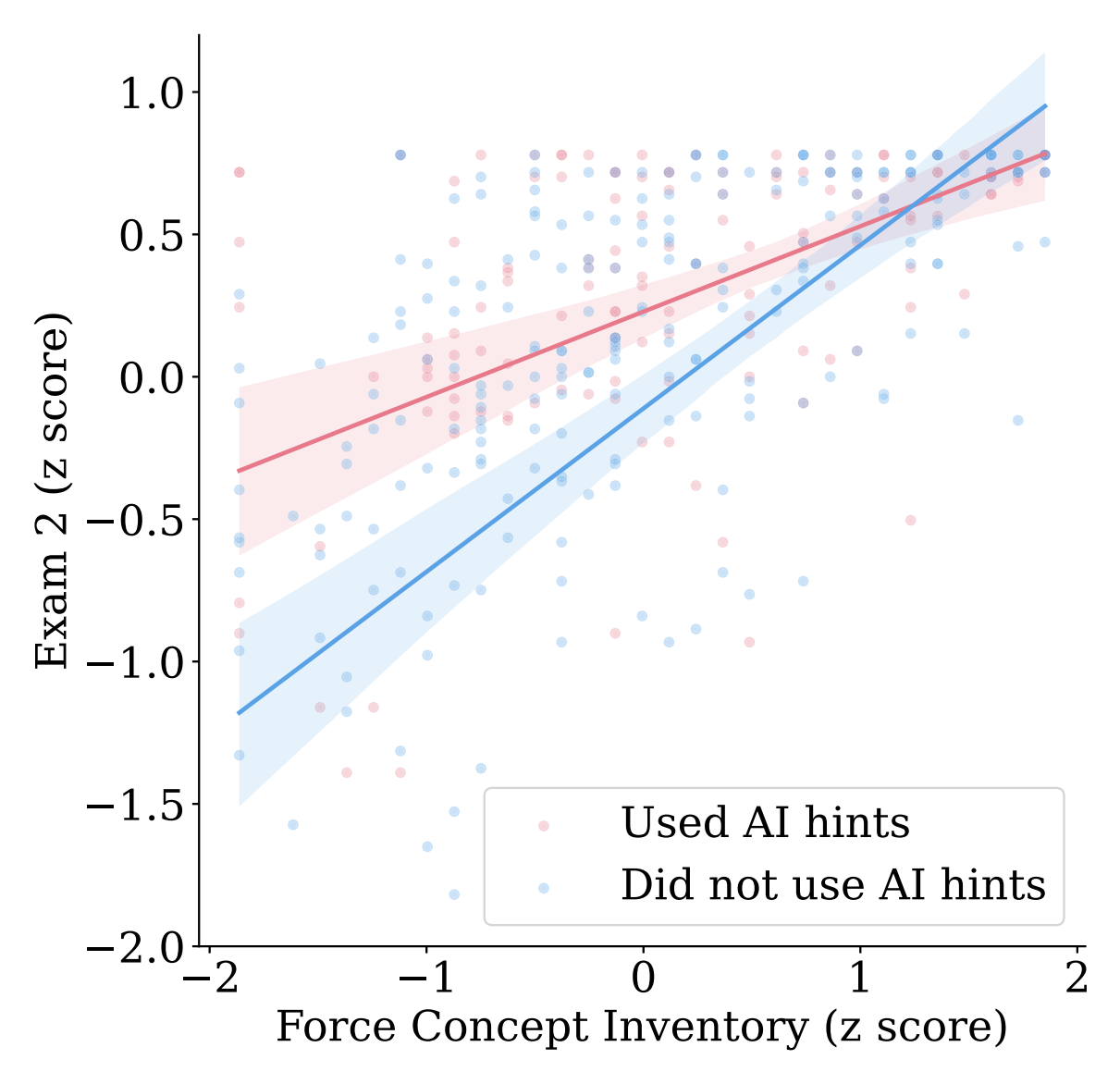
Researchers at UCLA and UC San Diego studied AI-generated hints delivered through Kudu in an introductory physics course. The result: AI-generated hints were associated with improved exam performance, especially for students who need help most.

"Our findings indicate that both these interventions are associated with increased exam scores."
Lu et al. (2025)
Published in Physical Review Physics Education Research (2025)Researchers: UCLA Center for Education Innovation and Learning in the Sciences (CEILS), in partnership with UC San Diego.
Read the full study
Figure 6 from Lu et al. (2025): exam 2 score against Force Concept Inventory score. Students who used AI hints scored higher, most of all those with the lowest inventory scores; the two lines meet near the top.
Figure 6 from Lu et al. (2025): exam 2 score against Force Concept Inventory score, separated by use of AI hints. The colored bands show 95% confidence intervals. Lu et al. (2025), CC BY 4.0, cropped.

HOW KAI WORKS

How a query travels — and what we promise about it.

Every KAI interaction follows the same path. The architecture is what makes the privacy and pedagogy commitments credible.

PROMISE 01

No identifying student data ever reaches a model provider.

PROMISE 02

No training on student or faculty queries. Contractually enforced.

PROMISE 03

Models can be swapped without changing the institution's contract.

RECOGNITION

Three Kudu educators selected as AI Innovators at ASU+GSV.

The AI Show at ASU+GSV is the largest gathering of edtech AI innovators in the world. Three educators building courses with Kudu were selected as AI Innovators, recognized for their work bringing usable, course-grounded AI into real college classrooms.

This is what it looks like when faculty get AI tooling that respects their pedagogy. Not a top-down rollout. Not a corporate platform announcement. Educators choosing the technology that matches their teaching.

2025 AI innovators built on Kudu

Prof. Zrinka Stahuljak

Prof. Zrinka Stahuljak

UCLA Comparative Literature

Elizabeth Landers

Elizabeth Landers

UCLA Humanities

Prof. Alex Kusenko

Prof. Alex Kusenko

UCLA Physics & Astronomy

A REAL CLASSROOM

Instead of banning AI, this UCLA literature class embraced it.

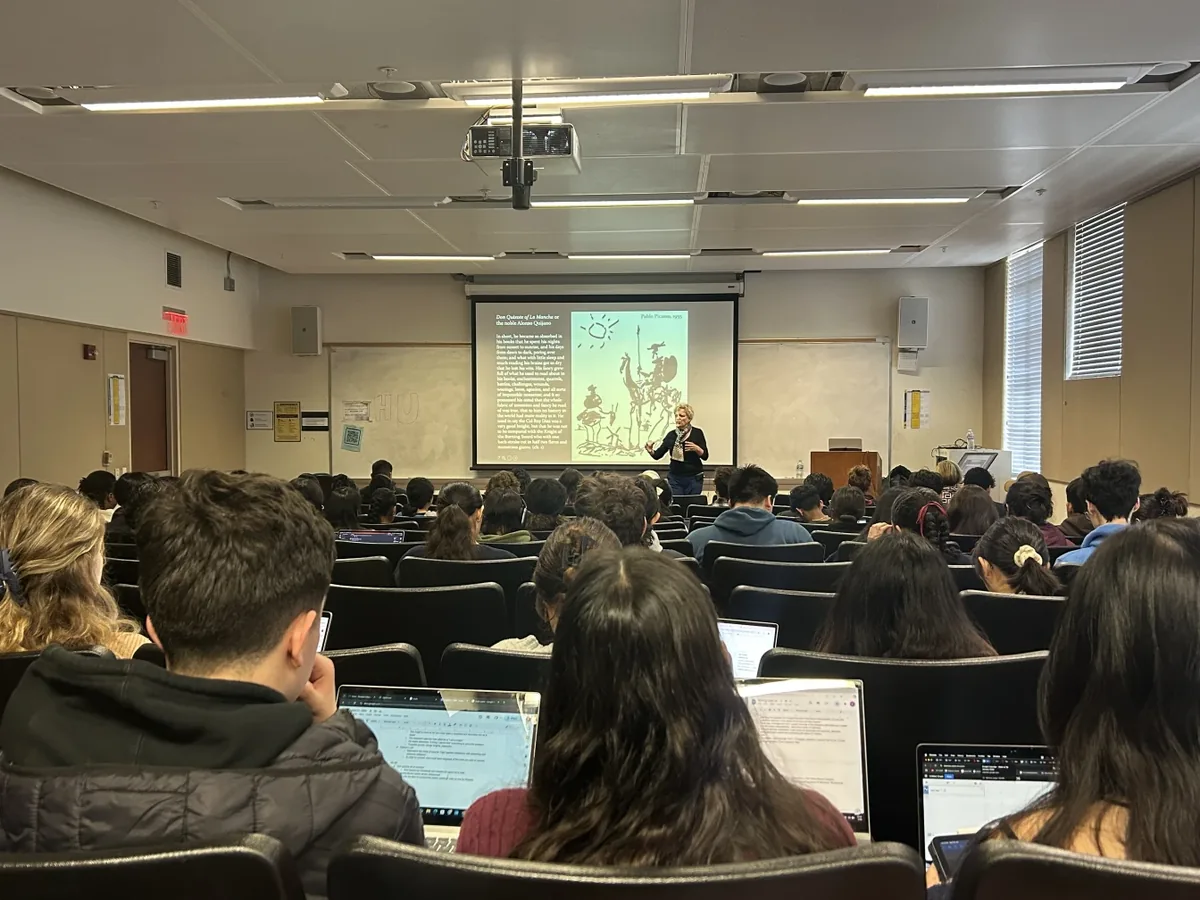
When AI showed up on campus, most humanities classes responded with prohibition. Professor Zrinka Stahuljak's comparative literature class at UCLA went the other direction, building a course where AI is a tool students learn to use thoughtfully rather than something to avoid.

The course's textbook, discussion guides, and homework were all built using Kudu's AI authoring system, with Stahuljak's materials and judgment as ground truth. The classroom AI tutor is grounded in the same content. Students learn the literature and learn to interrogate AI's relationship to it. The course made the front page of LAist.

"Instead of banning AI, this UCLA literature class embraces it."LAist, February 2025
Read the full story
Professor Zrinka Stahuljak's comparative literature classroom at UCLA.

HARD QUESTIONS, ANSWERED

The questions we get most about KAI.

Won’t students just use KAI to cheat?

KAI is designed not to give answers. It tutors by asking leading questions, offering partial hints, and walking students through their own reasoning. Students who want to use it to short-circuit their learning will find it less useful than ChatGPT, which is what the research bears out: students using KAI actually do better in class than students who don't.

Does Kudu train AI on student data?

No. Queries are anonymized before they leave Kudu's infrastructure, and we use frontier model providers under contractual no-training agreements. We don't sell data, we don't share data, and we don't train anything on student or faculty queries. The architecture is structured so we couldn't, even if we wanted to.

What happens when a better model comes out?

We route to it. Institutions don't pick a model provider when they choose Kudu. Kudu holds those relationships and swaps in the best available models for each task. Your campus gets frontier capability from this year's best AI without renegotiating an AI vendor contract.

How is KAI different from ChatGPT EDU?

ChatGPT EDU is a general-purpose AI provided to a campus. KAI is course-specific tooling grounded in the actual textbook and configured by the faculty. ChatGPT EDU helps students do anything; KAI helps students learn the course they're taking. They are complementary tools: KAI replaces the in-course tutoring, not the school-wide AI service.

Can faculty see what students ask?

Yes. Faculty and student support staff can review aggregate query patterns to see what students are struggling with, what topics generate the most confusion, and where the textbook needs clarification. KAI becomes a signal about the course's friction points rather than a black box.

Is KAI FERPA-compliant?

KAI is built to operate within FERPA-aligned data handling. Student-identifying information is not transmitted to model providers. Your IT or privacy office can write to support@kudu.com for details.

KAI

The AI position higher ed has been waiting for.

Equity. Pedagogy. Privacy. Validated outcomes. And it costs your institution less than what you're paying for AI subscriptions today.